The honest part
What a playpen with no floor stands on
A soft-sided pen is an edge, not a room. What goes underneath it, what the federal rule calls a play yard, and why the difference matters at bedtime.
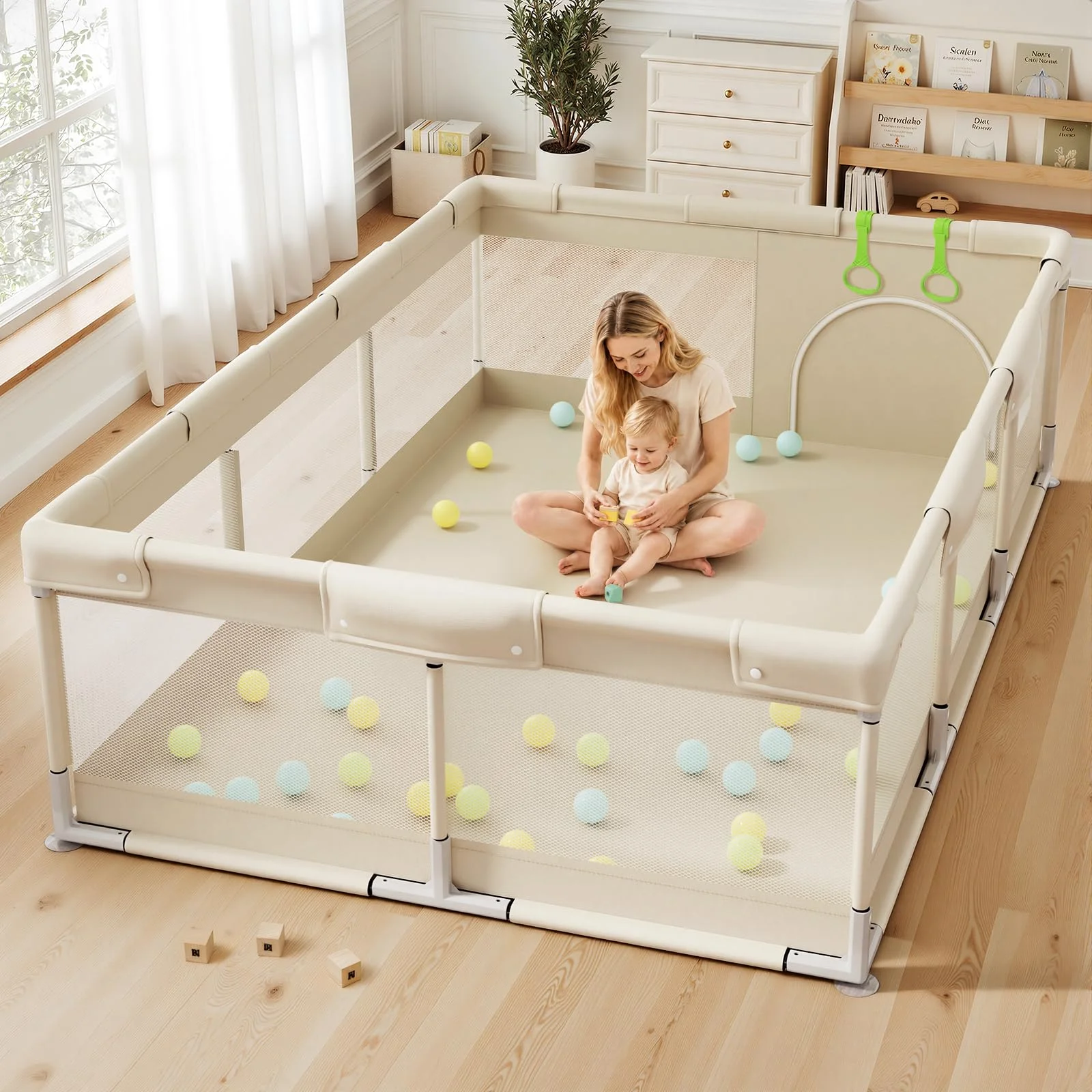
What these soft-sided pens are, and what they are not
These soft-sided pens are fabric panels stretched over a tube frame, with breathable mesh running the full height of all four sides. The panels stand 26 inches high and the footprints are measured on the outside of the panels. You can choose a square footprint that is 47 by 47 inches or a rectangular footprint that is 71 by 47 inches. One of the 47 by 47 models arrives with a cotton mat that straps to the base with crossed velcro and goes in the washing machine. Two of the three models ship without a base in the box. A gate zips from the outside so a child inside cannot reach the pull. The inside faces include pull-up rings for toddlers. The outer faces include pockets. Corners are padded. Suction cups sit underneath on each pen. The fabric is Oxford fabric and the pens assemble without tools. Prices range from $42.99 to $89.99.
That is a list of parts, and it is worth being plain about what it is not. The U.S. Consumer Product Safety Commission defines a play yard as "a framed enclosure that includes a floor and has mesh or fabric sides." The floor is part of that definition. Two of these three pens arrive without one, so what stands in your living room is a soft-sided enclosure with mesh, pockets and a zip gate, resting on the floor you already have.
Why a pen without a floor is not a play yard in the Commission’s terms
The U.S. Consumer Product Safety Commission defines a play yard as "a framed enclosure that includes a floor and has mesh or fabric sides," intended for use in or around the home and for travel, and for a child who cannot climb out and is under 35 inches tall. The federal rule for play yards sits at 16 CFR part 1221 and takes in the ASTM F406 standard. According to the Commission, that rule and standard cover side height, side deflection and strength, floor strength, mesh and fabric requirements, latching mechanisms, stability, cord and strap length, and permanent labeling. Those are the specific elements the Commission lists as part of the play yard regulatory framework.
Floor strength is one of the things that rule tests, which tells you how central the floor is to what the Commission is describing. A pen with no base of its own gives that test nothing to measure.
None of that makes a soft-sided pen a worse object than it is. It makes it a different object from the one the federal rule is written about, and the difference matters most at bedtime.
What a pen actually stands on in your room
In everyday use, a soft-sided pen ultimately bears down on whatever is under it in your room. The pen’s outside footprint is what contacts the floor. For the two main sizes listed here, that footprint measures 47 by 47 inches and 71 by 47 inches. Each panel reaches 26 inches high. Suction cups sit beneath the pen and touch the floor along with the tubes and feet of the frame. Those contact points together determine how the pen sits and how weight and movement distribute across the surface.
Different floor surfaces change the feel and the contact. On a hardwood floor the suction cups are likely to meet a smooth plane, while tile provides another flat surface. Carpet presents texture and compressibility. If the floor is uneven, one side of the footprint may bear more load than the others. The pen does not come with a rigid floor in most models, so the floor you already have becomes the bottom of the enclosure in practice.
You will notice small shifts when a child moves inside and when you lift or press at the frame. The outer panels are measured on the outside, and that measurement is the best guide to how much floor space the pen occupies. Use the footprint numbers when you plan placement in a living room. Leave room for people to walk around the pen and for any mat you plan to put beneath it. The surface you choose under the pen is its base, unless you have the version whose cotton mat straps to the frame.
How mats fit under a pen, with the arithmetic you need
The foldable foam mats made to go under these pens have specific dimensions and a thickness you can account for. Mats are 0.4 inches thick with XPE closed-cell foam, printed on both faces and a waterproof top skin. They fold to about a third of their open size. Available mat footprints are 59 by 59 inches, 71 by 59 inches, and 79 by 71 inches. Use those figures to plan margins around and under a pen.
For a 47 by 47 inch pen, a 59 by 59 mat gives 12 inches more in each direction. That arithmetic works out to a six-inch margin around the pen on every side when the pen is centered on the mat. If you place the 47 by 47 pen on a 71 by 59 mat you will have 24 inches extra along one axis and 12 inches along the other. In that case you get a 12-inch margin on the long axis and a six-inch margin on the short axis if the pen sits centered.
For the 71 by 47 inch pen the 79 by 71 mat leaves eight inches extra along the long axis and 24 inches extra along the short axis. That equals a four-inch margin on each side of the long axis and a 12-inch margin on each side of the short axis when centered. Those are the straightforward subtractions and halves you can do with the sizes given.
Also account for mat thickness and folding if you will move or store the mat. The mat is 0.4 inches thick and folds to about a third of its open footprint for transport. If you are centring a pen on a mat, measure twice and then place the pen and mat together to confirm the margin you want in your living room.
Why a loose mat can ride into a corner, and what straps do
A foldable foam mat under a soft-sided pen can move when one edge meets a panel. The mat surface is waterproof and printed on both faces, so friction against the pen fabric varies by material and floor below. When a child crawls toward a wall or pulls up on the mesh, the mat can bunch or fold along a seam. A fold creates thickness at one corner. That thicker edge can catch and then slip further into the small gap between the framed tube and the fabric panel. A fold and a week of pushing and pulling put that ridge in a corner.
A 0.4 inch foam mat folded to about a third of its open size develops layers that are thicker than the flat mat. When those layers press against the interior face of the pen, they tend to move toward the nearest corner under the action of repeated pushes and tugs. The result is a folded ridge at a corner rather than a flat, contiguous surface underfoot.
One 47 by 47 pen ships with a cotton mat that straps to the base using crossed velcro. Those crossed straps are designed so the mat does not shift relative to the frame in the same way a loose mat can. The cotton mat goes in the washing machine as supplied. Suction cups under the pen and the presence or absence of a mat also change how the bottom contacts the room floor. A strapped mat stays aligned with the frame. A loose foldable mat needs some attention to keep it flat and centered.
If you will use a loose mat, position the mat first and then assemble or center the pen on top of it. That order reduces the chance of a fold being trapped at the moment you set the pen down. If the mat begins to bunch, unfasten the pen panels and re-center the mat. The crossed velcro solution is one factory-provided way to prevent migration on the one model that includes a cotton mat.
What fifteen minutes with the pen up is actually for, and a plain line about sleep
Many people use a soft-sided pen for short supervised intervals. Fifteen minutes with the pen up often buys time to start a load of laundry, answer the door, or make a quick meal while staying close by. It is a place to keep toys contained and give you a clear sightline into the pen through the full-height breathable mesh. You remain the supervisor. The pen enables brief hands-free moments while you watch and respond quickly.
Short intervals work because the pen keeps toys and a child in a defined area while you do something next to the pen. Do not treat these short spans as unsupervised time. A gate that zips from the outside is designed so a child inside cannot reach the pull. Pull-up rings on the inside face are there for interaction and balance, not for unattended use. Pockets on the outer face and padded corners are convenience features. Suction cups underneath affect how the pen meets the room floor but they are not a substitute for supervision.
The U.S. Consumer Product Safety Commission asks parents to use products intended for sleep: cribs, bassinets, play yards and bedside sleepers that meet federal requirements. The Commission asks that the sleep space be bare except for a fitted sheet, that a baby be placed on their back, that a baby who falls asleep somewhere else be moved to that sleep space, and that a baby not be left unsupervised in products that are not designed for safe sleeping. Keep that guidance in mind when you decide how to use a pen in your living room.