Arithmetic
How much floor a crawler covers
Twenty-four square feet, thirty-nine square feet, and the coffee table you were going to push back anyway: what the mat sizes mean once they are on a real floor.
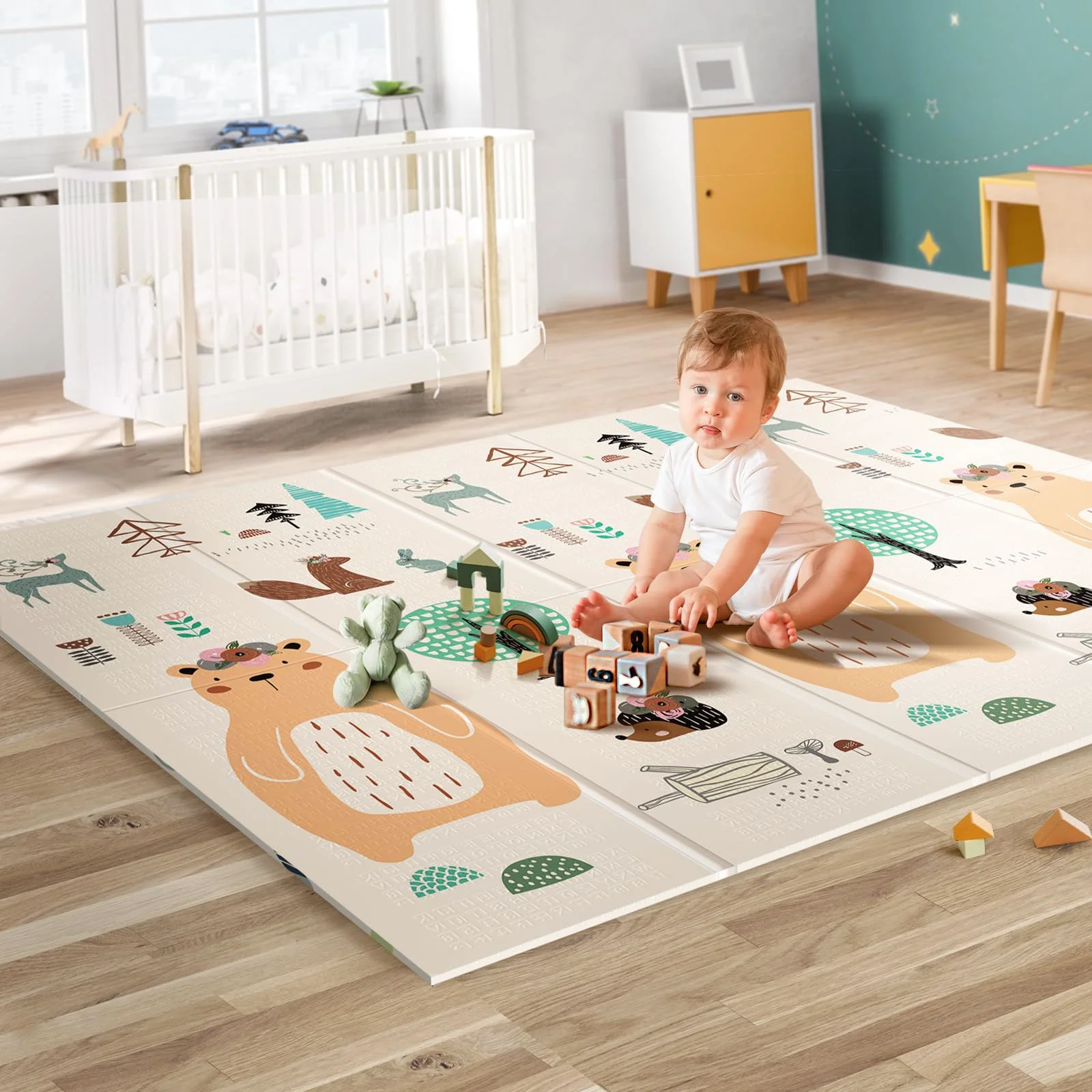
What floor space means for a crawler
When a baby starts to roll and push up, the space you clear matters more than you expect. A 59 by 59 inch mat covers 24.2 square feet. A 71 by 59 inch mat covers 29.1 square feet. A 79 by 71 inch mat covers 38.9 square feet. Those figures give a quick sense of the footprint each mat will occupy on your living room floor. All mats are 0.4 inches thick and made from XPE closed-cell foam. Both faces are printed with different designs and the top skin is waterproof, so a damp cloth will clean it. Each mat folds along the printed creases to roughly a third of its open size. Some designs come with a carry bag.
Tummy time is a common early reason to bring a mat into the room. The National Institute of Child Health and Human Development defines tummy time as placing a baby on their stomach while they are awake and someone is watching. That agency also notes most babies can start a day or two after birth, with two or three sessions of three to five minutes a day. By about two months, pediatricians recommend fifteen to thirty minutes a day in total. The Centers for Disease Control and Prevention lists holding the head up during tummy time as one of the movement milestones for two months.
Those recommendations shape how you plan the floor area. Short sessions on a smaller mat can work in a tight city living room. A larger mat gives room for rolling and reaching without bumping furniture. Match the square-foot figures to the actual cleared rectangle in your living room and you will know what fits before you move the sofa or the coffee table.
How much difference an extra 12 or 20 inches makes
Linear measures look small until you translate them into area. Moving from a 59 by 59 inch mat to a 71 by 59 inch mat increases covered area from 24.2 square feet to 29.1 square feet. That is a rise of 4.9 square feet, roughly 20 percent more floor. A jump from the 71 by 59 up to the 79 by 71 inch mat is larger. The increase runs from 29.1 square feet to 38.9 square feet. That adds 9.8 square feet, about 34 percent more room.
Compare the smallest mat to the largest and the change looks dramatic. The 59 by 59 inch mat at 24.2 square feet versus the 79 by 71 inch mat at 38.9 square feet adds 14.7 square feet. In percentage terms that is around a 61 percent increase in floor area. The reason is simple. Area grows on both axes. A twenty inch gain on one side and a twelve inch gain on the other multiply together. That produces a larger change than the raw difference in single dimensions suggests.
Think in terms you can measure with a tape. If your cleared patch of floor has a long side constraint, like an entertainment unit, a small increase in one dimension might force you to expand the other. A mat that seems only slightly wider may demand a different placement for the sofa. The visual footprint also changes. A larger mat will cover more floor pattern or hardwood grain, so it may be more conspicuous than the numbers imply.
Deciding between sizes comes down to how much clearance you can spare on both axes. If you plan to use the mat directly under a playpen or beside a coffee table, factor in those edges.
Clearing the room and measuring the real shape
A cleared floor rarely lives in a perfect rectangle. Door swings, stair gates and coffee tables break up the space you have. Start by measuring the longest uninterrupted stretch of floor where the mat could lie. Mark any obstructions that will sit atop the foam such as a coffee table leg or a TV stand base. If a doorway opens into the area, test the swing. A door that must open across part of the mat will lift an edge when it moves. That creates a trip hazard for adults and a disturbance for the baby.
Measure from wall to wall and from the front of the sofa to the coffee table. If the sofa protrudes, the usable rectangle shrinks. Measure the clearance around the furniture legs. A mat requires a flat surface underneath to lie flat. Flooring transitions matter too. Thresholds, rugs and heater vents can create a hummock where the mat will not sit evenly. The mat’s thickness is 0.4 inches, which is thin enough to pass under many door clearances but not all. Test the threshold with a tape and, if possible, a sample plank or folded towel to simulate the bump.
When a doorway interrupts a corner, you can rotate the mat. A 59 by 59 inch square can be set diagonally if the room allows, which changes the effective footprint. Cutting out an L-shaped patch of floor to accommodate a coffee table often leaves enough space for a smaller mat but not a larger one. Measure the diagonal distance if that arrangement appeals to you. Folding also affects the day-to-day routine. Each mat folds to roughly a third of its open size, so plan how you will store the folded mat when the area returns to adult use.
If you add a playpen or a second child
Playpens change how you plan floor space. The pens come in two outside footprints. One measures 47 by 47 inches with panels 26 inches high. Another option measures 71 by 47 inches. Two of the three pens have no floor of their own and stand directly on whatever floor is in the room. One 47 by 47 inch pen arrives with a cotton mat that straps to the base with crossed velcro and is machine washable. The pens have fabric panels over tubing with breathable mesh on all four sides. They include a zip gate that opens from the outside, pull-up rings inside, pockets on the outer face and suction cups underneath. Pens run from $42.99 to $89.99.
A common setup is a mat beneath the pen. A 59 by 59 inch mat under a 47 by 47 inch pen leaves six inches of margin on each side. That margin gives a small buffer when the baby reaches to the mesh. Put the 71 by 59 inch mat under the 71 by 47 inch pen and the long sides match exactly, with six inches of mat showing along each of the short sides. Two children on the floor change the calculation again. If a second crawler joins, the 79 by 71 inch mat offers far more uninterrupted space at 38.9 square feet. Two children who are both moving want three feet of clear foam each, and that is what the difference between 24.2 and 38.9 square feet buys you.
Think about access and supervision. A zip gate that opens from the outside makes entry simple for you. Position the pen so the gate faces a clear path and not a piece of furniture you must move. If a pen sits on a hardwood floor that slopes slightly, use the suction cups to reduce sliding. When you plan two activity areas, leave enough corridor to move between them without stepping on the mat. That preserves the foam and keeps the mat from bunching.
Folding, carrying and tucking away
Folding changes how often you need to re-think the room. Each mat folds along printed creases to roughly a third of its open size. That reduces its footprint in storage and makes lifting easier. Some designs include a carry bag which helps when you move the mat between rooms or take it to a relative’s house. The foam is XPE closed-cell, so it resists moisture and will not sag the way a thicker padded rug might.
Store the folded mat upright behind a couch, stand it in a closet corner, or slide it vertically under a bed if there is clearance. Folded, the sheet is several layers of 0.4 inch foam stacked on each other, so the parcel is thicker than the mat and much smaller than it. Test your intended storage spot with a tape measure and a folded towel to simulate the pack. If you use a carry bag, check its handle position and whether it will hang from a peg or fit on a shelf.
Folding also affects how fast the mat is ready for use. A mat that folds to a compact size will be quicker to put down at playtime and faster to stow afterwards. The printed creases give a repeatable fold, keeping edges aligned and making it easier to tuck the mat away neatly. Designs and patterns matter for storage only to the extent that a double-sided print lets you show a different face before you fold it. If the mat will be moved through tight hallways, plan the carry path so you do not drag corners over doorknobs or chair backs.
One thing to do before folding: wipe the face that has been on the floor. Whatever a day leaves on it goes into the bag with the mat otherwise, and comes back out on the next unfolding.
Layout examples and a quick reference table
Place the tape measure on the floor and try a few arrangements before deciding. A 59 by 59 inch mat fits comfortably in many small living rooms. The 71 by 59 inch mat offers extra room along one axis without doubling storage needs. The 79 by 71 inch mat gives the largest cleared rectangle and suits households that want space for two activity zones. Combine a 59 by 59 inch mat with a 47 by 47 inch pen and you will have six inches of margin each side. Use the larger mat sizes if you expect rolling, crawling and a second child to share the floor.
The footprints, side by side, with what each one covers.
| Item | Footprint (inches) | Square feet | Notes |
|---|---|---|---|
| Small mat | 59 x 59 | 24.2 | Folds to roughly a third of open size, 0.4 in thick, XPE closed-cell foam |
| Medium mat | 71 x 59 | 29.1 | Both faces printed, top skin waterproof, some designs include a carry bag |
| Large mat | 79 x 71 | 38.9 | Largest footprint in the range, same thickness and materials |
| Small pen | 47 x 47 | N/A | Panels 26 in high, one arrives with a cotton machine-washable mat |
| Wide pen | 71 x 47 | N/A | Fabric panels with breathable mesh, a zip gate, suction cups |
Use a tape to map the actual rectangle available, then compare it to these footprints. If a doorway swings through part of the planned rectangle, simulate the swing with a tape and a folded towel. If the pen will share the mat, position the gate toward a clear path. Finally, remember the baby milestones. The National Institute of Child Health and Human Development and the Centers for Disease Control and Prevention recommend starting tummy time early and building up to fifteen to thirty minutes a day by about two months. Plan the floor so those sessions happen easily and without daily furniture gymnastics.