The first week
The crease in a new foam mat, and when it stops
It arrives folded, it lies proud of the floor for a day or two, and then it does not. What is actually happening, and what makes it quicker.
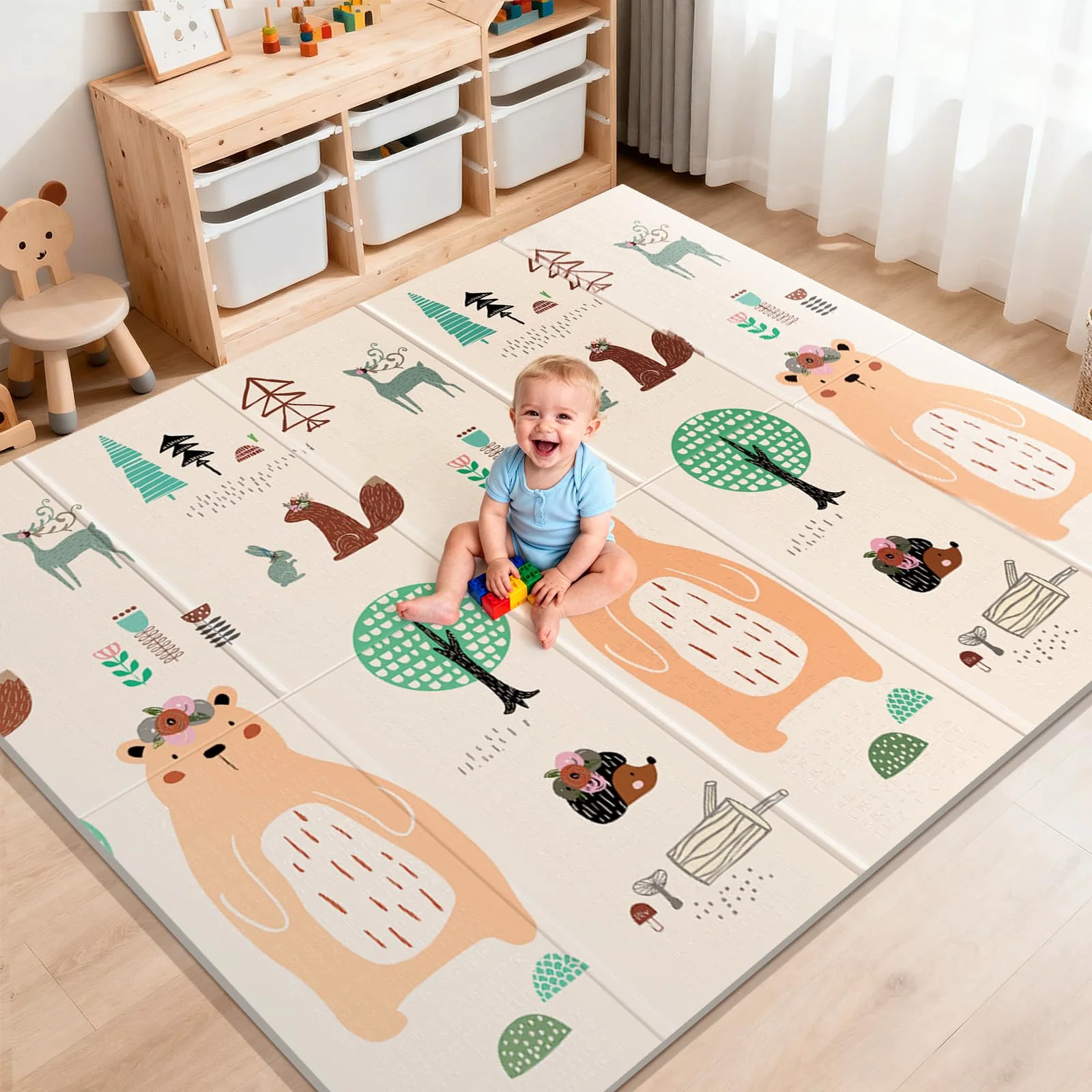
What the crease is
A new UANLAUO mat arrives folded along printed creases. Those lines are where it folds: they do not disappear, they settle. The material is XPE, a closed-cell foam, and the sheet is 0.4 inches thick. Closed cells hold their own air. That is why a sheet this thin still has spring, and why a spill sits on the surface instead of soaking in. The printed crease is a mechanical bend in a thin, springy panel. When the mat is folded, the foam at the fold compresses and the cell structure changes shape. Nothing mysterious is happening. The fold is simply the foam adopting a shorter form along the printed line.
Both faces of the mat are printed with different designs. Either side can be the one facing up. The top skin is waterproof and wipes clean with a damp cloth. That skin keeps the folded panel from absorbing surface moisture when it ships or when you wipe it on arrival. If your mat came with a carry bag, that accessory affects how tight the fold was during transit. A tighter bag compresses the foam more strongly, which can make the crease feel firmer on first unfolding.
Expect to see the fold clearly at first. The line will sit proud against the rest of the surface. Foot traffic and the foam’s internal air will work together to soften that line over time. Heat and weight encourage the cells to relax. Cold and lack of pressure keep them held in the folded position. For now, treat the crease as a normal part of a folded closed-cell sheet and not as a defect.
Your first evening with the mat
You will notice the crease the moment you lay the mat flat. It reads as a visible ridge where the printed line sat during shipping. The rest of the mat will lie flat against the floor, while the folded segments retain a slight crown. At 0.4 inches thick, the foam has enough spring to push the folds upright for a while. That is normal and expected. A tile floor will keep the foam stiffer, so the crease holds its shape longer than it would on a warm rug.
Place the mat where you want it to live and let it settle naturally. You can walk across it, sit on it, and let toys do their work. Weight is one of the reliable ways the mat relaxes. Repeated pressure opens some of the compressed cells back toward their original form. Keep spills to the surface. The top skin is waterproof and wipes with a damp cloth. No cover comes off and nothing goes in a washing machine, so cleaning that evening is straightforward.
If you are concerned about edges catching a door, check clearance before the first night. The mat is 0.4 inches thick and clears the swing of most interior doors. Not all doors clear every edge. A door that catches an edge lifts it. A lifted edge becomes a lip that a new walker will notice. You do not need to correct the crease immediately. The mat was printed and folded at the crease to make shipping compact. Allow it time and body weight to work. If you prefer, position the printed face you want up now. Both faces are printed, so flipping the mat later is an option.
How warmth, weight, and the floor change the crease
Closed-cell foam behaves like a thin, air-filled panel. The cells push back when compressed, and warmth makes them softer. A warm room helps the compressed cells relax more quickly. A cold floor makes foam stiffer, so folds hold their shape longer on tile than in a warm room. Weight is the other main factor. A child crawling across the mat applies repeated, distributed pressure. A couch or coffee table on part of the mat applies steady pressure. Both actions nudge the compressed cells toward a flatter profile.
The mat folds to roughly a third of its open size for shipping. The relationship between size and folded bulk matters for how strongly the crease forms. For example, a 59 by 59 inch mat folds to about the footprint of a small suitcase. A third of 79 inches still wants a closet. The three footprints, and what each one becomes once it is folded:
| Open size (inches) | Folded |
|---|---|
| 59 × 59 | About the footprint of a small suitcase, and it goes behind a door |
| 71 × 59 | Roughly a third of the open size, and it stands against a wall |
| 79 × 71 | Roughly a third again, but a third of 79 inches wants a closet |
If the mat sits on a carpet, the soft surface lets more of the fold press flat. On tile, the same fold remains visible for longer. You can use body weight in a gentle, repeated way to encourage relaxation. Place heavier items across a crease for an hour or two. Do not expect immediate disappearance. The crease settles. It does not vanish. Over time the interplay of warmth, weight, and daily use makes the line less pronounced.
Why heat guns, irons, and hot water are not the answer
A quick fix might seem tempting. Pointing a heat gun, laying an iron on the surface, or pouring hot water over a crease all share an instinct: apply heat to soften and reshape. That instinct overlooks how the mat is made. The foam is a closed-cell XPE sheet with a waterproof top skin. Heat concentrates at a point and can change the skin and the cell structure unevenly. That is a risk for the printed surface and for the foam beneath. High, focused heat can cause bubbling, discoloration, or a change in the surface that a wipe will not fix.
Hot water carries a similar problem. The top skin is water resistant, but prolonged exposure to heat and liquid at a seam or edge can force moisture where it does not belong. The mat is not designed to be steamed or soaked for reshaping. An iron applies pressure and heat at once. That combination flattens some cells while further compressing others. The result can be an irregular surface that looks worse than the original crease. Professional reshapings or industrial heat treatments are not part of the product or its care instructions. You have reliable, gentle methods that work better: warmth from the room, regular use, and steady distributed weight.
If you want to speed the settling without risk, create even pressure across the crease with household items that spread load. A stack of magazines under a flat board works. Place the board across the crease and position a modest weight on top. Keep the assembly in place for a measured period, then remove and check. Repeat if needed. This method uses the foam’s natural response to pressure and warmth and avoids concentrated heat or direct contact with heating elements.
Doors, lifted edges, and what a permanent lifted edge means
Some door swings meet the mat edge. At 0.4 inches thick, the mat clears most interior doors. Not every door clears every mat. If a door catches an edge, it lifts the mat. That lifted edge becomes a small lip. A new walker will notice that lip as a change in surface height. The lip can cause toys to snag and make the edge feel different underfoot. It is a persistent effect because the folded edge resists being flattened by intermittent pressure from a door.
To decide whether a lip is permanent, watch how the mat behaves over a few days. If repeated normal use flattens the edge, the lip is temporary and the crease is settling. If the door keeps lifting the edge each time it swings, the mat will continue to reform at that junction. You then have two choices. Shift the mat slightly away from the door swing so the door clears cleanly. That simple move removes the repeated lifting force. Alternatively, change the door clearance by adjusting the door or the mat placement. You can also rotate or flip the mat. Both faces are printed, and flipping may present a different edge to the door.
A permanent lifted edge is not a defect in materials. It is the result of repeated, asymmetric force at a specific line. The mat was folded to make shipping compact, so the printed crease is already a natural weak line where the foam bends. When a door keeps lifting that section, it reinforces the line in the same shape. Removing the repeated lifting force removes the reason the lip persists.
Folding for storage and the look of an old crease
If you will fold and unfold the mat frequently, learn a folding rhythm that keeps the crease predictable. The mats are manufactured to fold to roughly a third of their open size. Folding along the printed creases means you return the foam to the same compressed lines each time. That consistency makes future unfolding familiar and faster. If you prefer a gentler storage fold, try folding to half the depth of the original crease, not more. That spreads compression across a wider stretch and reduces sharpness the next time you open it.
Store the folded mat in a carry bag when that accessory is supplied. A bag keeps dust off and holds the fold in a consistent shape. A tighter compression in a bag makes the crease firmer at first. If you alternate between a bag and open storage, the crease will develop differently than a mat that lives open on the floor. A mat left flat develops broad, shallow wear patterns from body weight and toys. A mat folded daily keeps concentrated lines where the fold happens.
After a year of regular folding and unfolding, an old crease looks different from a new one. Expect the printed line to be softer and less proud. Repeated compression and relaxation change the cells near the fold so they accept the bent shape more readily. The surface will still wipe clean with a damp cloth, and either printed face remains usable. The long-term character of the crease simply becomes part of the mat’s appearance. It is a record of how you used the mat: a mat that lives open will show different signs than one that travels in a carry bag. Both patterns are normal. The crease settles, the mat keeps its spring, and the surface stays easy to clean.